

You spread pine straw evenly across every bed on your property, yet within weeks, some areas look bare while others pile up like miniature drifts. This isn’t a fluke-pine straw settles differently across landscape bed designs because of measurable differences in slope, soil, drainage, shape, and exposure. Understanding why these settling patterns occur is the first step toward achieving even coverage that lasts through every season. This blog breaks down the specific factors that influence settling, explains how common bed designs create unique distribution challenges, and shares professional installation techniques that keep your pine straw mulch looking tidy from day one.
Key Takeaways
- Bed slope, shape, and drainage patterns are the primary factors determining how pine straw settles.
- Formal geometric beds require different installation techniques than natural curved designs.
- Proper edging and installation depth prevent uneven settling in all bed types.
- Understanding your specific bed design helps predict and prevent settling issues.
- Professional installation techniques ensure consistent coverage regardless of landscape design.
Primary Factors That Influence Pine Straw Settling Patterns
Pine straw behaves dynamically depending on the landscape design and material properties at play. Four primary forces-slope, soil composition, drainage, and wind-interact with your bed’s design to create the settling patterns you observe after installation.
Slope and grading are the most influential variables. On flat areas, pine needles settle relatively uniformly, compressing under their own weight after moisture contact. On steeper beds, gravity pulls straw downhill before it can interlock. Landscape professionals categorize slopes as gentle (under 5% grade), moderate (8–16%), and steep (20% or more), with each category demanding progressively more aggressive installation techniques. The University of Georgia Extension documents that steeper slopes require thicker initial layers-3 to 4 inches rather than the standard 2 to 3 inches-to allow enough mass and interlocking structure to resist erosion. Without this adjustment, pine straw at the top of a slope thins out and exposes soil, while needles accumulate at the bottom.
Drainage patterns and water flow reshape pine straw placement after every heavy rain. Beds that receive concentrated runoff from roof lines, driveways, or other impervious surfaces tend to wash out straw near entry points. Freshly laid pine straw can settle by 20% to 30% after the first heavy rain, but that settling isn’t uniform-water channeling through a bed creates thin streaks and thick deposits. In rainfall simulation studies, straw mulch significantly reduced soil loss, but in clay soil settings, straw performed relatively worse in resisting displacement under intense rainfall rates of 2 to 6 inches per hour.
Wind exposure causes the most frustration in the first days after installation. Pine straw is lightweight and can be blown away easily in windy areas, especially before it has been wetted or allowed to interlock. Applications under 2 inches fail under moderate wind conditions, while a 3-4 inch depth provides sufficient weight against wind forces. Beds at the top of slopes, corners of properties, or open front-facing garden beds lose the most straw to wind. Lightly watering after installation helps needles lie flat and begin forming the interlocking mat that resists displacement.
Factors like needle type, moisture exposure, and installation depth influence how pine straw settles. Longleaf pine needles are 8-18 inches long and interlock better than other varieties, while slash and loblolly pine needles are only 3-6 inches long and offer less structural cohesion, illustrating the differences between pine straw vs pine needles. Fresh pine needles retain flexibility and natural oils that enhance interlocking, making needle quality a critical but often overlooked variable.
Soil Composition and Settling Behavior
North Georgia’s soils present unique settling challenges that homeowners across the region recognize immediately. The red clay soil common throughout Metro Atlanta, rich in iron oxides, interacts with pine straw in ways that differ sharply from the sandy or loamy soils found in other parts of the state.
On clay-heavy soil, pine straw becomes heavier once wet. Moisture causes the layer at the soil interface to stick, creating initial resistance to movement. However, clay’s slow infiltration rate generates more surface runoff, so straw near downslope edges may erode or slide during storms. During dry periods, clay can crust over, reducing friction between the soil surface and the straw layer above it. Pine straw mulch can help retain soil moisture effectively, but on compacted clay, the moisture retention can work against stability if pooling occurs.
On sandy or loamy soils, pine needle tips penetrate the soil surface more easily, creating a mechanical grip. But because sandy soil doesn’t hold moisture long, the cohesive mat that keeps straw in place forms more slowly. Decomposition in sandy soils tends to occur at a slightly different pace-the lower microbial activity preserves thickness longer, but movement by wind and rain remains a greater risk until the mat is well established.
Moisture content affects pine straw’s weight and stability in every soil type. Moist straw flattens under its own weight and interlocks; dry straw remains fluffy with lifted needle ends that create loose, vulnerable edges. A 4-inch layer of pine straw weighs three times more than a 2-inch layer, which is why depth directly correlates with stability. This moisture-driven settling explains why fresh bales in Georgia often look dramatically thicker than the final settled depth-expect that initial 20–30% reduction once rain arrives.
How Different Landscape Bed Designs Affect Pine Straw Distribution
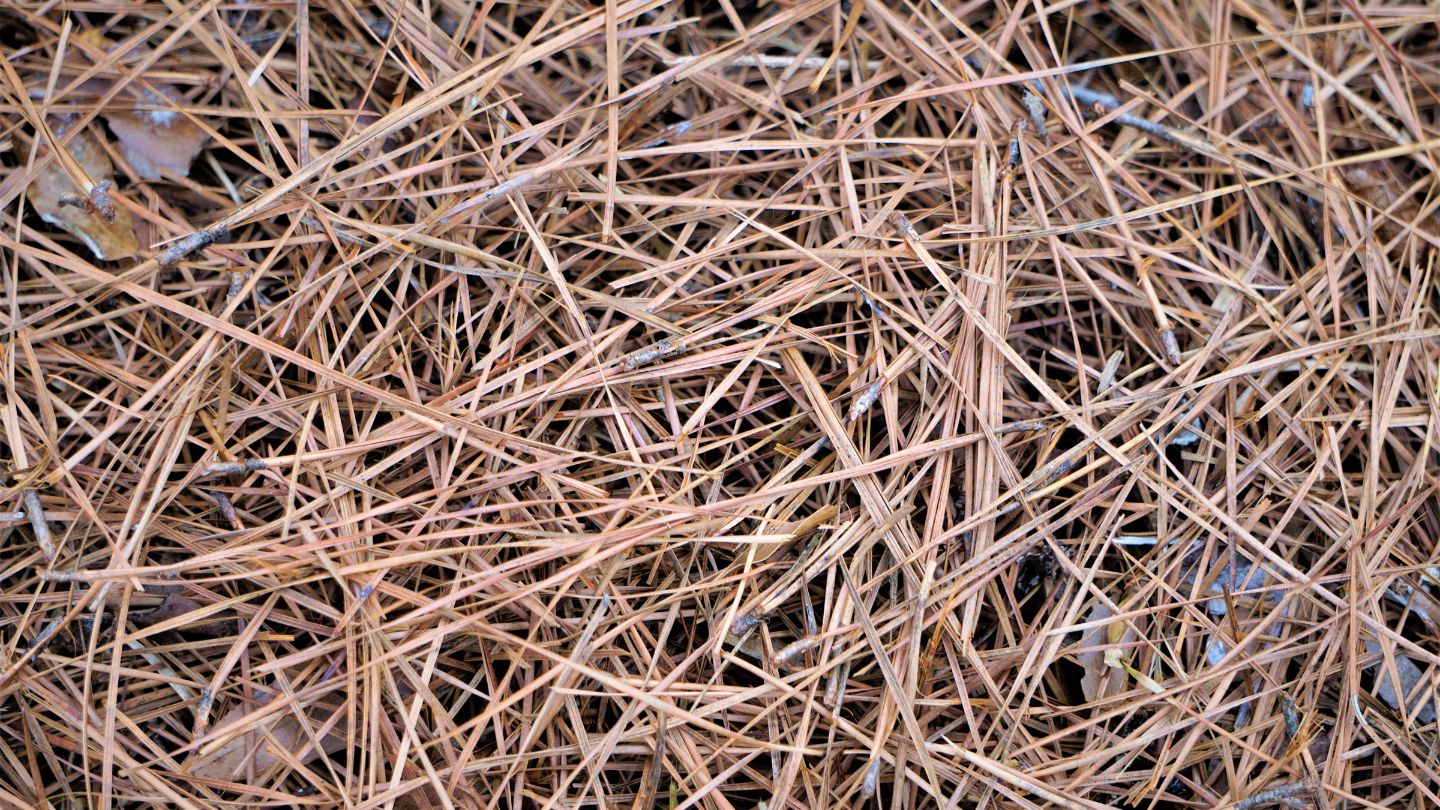
Not all garden beds are created equal when it comes to holding pine straw in place. The geometry, elevation, position, and size of a bed each create distinct settling dynamics that require tailored approaches.
Formal geometric beds with straight edges and clearly defined borders-brick, stone, or concrete edging-tend to maintain consistency in application depth. Defined edges in landscape beds help keep pine straw contained. The physical barrier prevents straw from sliding or drifting beyond bounds, and the predictable shape makes it easier to spread pine straw at uniform depth. However, sharp corners and the base of straight retaining walls can collect extra straw when runoff from higher ground is diverted into those pockets, creating thick deposits while other sections thin out.
Natural curved beds and freeform shapes present the opposite challenge. Irregular perimeters make even coverage harder to achieve during installation. Straw tends to migrate outward on convex curves where centrifugal water flow pushes it and accumulates in concave curves where debris naturally collects. Without rigid edging, the boundary itself becomes a weak point where pine needles escape into the surrounding lawn.
Raised beds hold pine straw notably well because side walls act as physical barriers on all sides. These beds typically have better drainage-when constructed properly-so water doesn’t pool at edges or push straw outward. The contained environment means settling is more uniform, though monitoring is still needed near plants where straw may thin as roots displace it.
Ground-level beds are prone to displacement at their perimeters, especially where surrounding terrain is slightly higher and directs runoff across or into the bed. These beds under trees may receive additional natural pine needles from above, but root systems at the surface can create uneven terrain that makes uniform depth difficult.
Sunken beds-areas that sit in natural depressions-collect water during rain events. The inward slope causes straw to wash toward the center, creating a thick core and thin rims. Pine straw is porous and allows moisture to evaporate while maintaining necessary air circulation, but in sunken areas where water lingers, excessive moisture can compact the straw prematurely and promote fungal concerns.
Island beds surrounded by turf or hardscape are exposed to wind and water from all directions. Without edging, the potential for straw to exit the bed is omnidirectional. Drainage may hit edges asymmetrically-perhaps more heavily from the driveway side than the lawn side-causing uneven thinning that creates a lopsided appearance.
Perimeter beds along fences, walls, or property lines benefit from having at least one fixed boundary. This reduces exposure from one side and helps trap pine straw along that border. But drainage from surfaces like driveways or roof lines may concentrate on these edges, washing adjacent straw away and leaving bare patches along the very border homeowners see most.
Bed size and shape compound these effects. Larger beds require more uniform spreading to avoid noticeable thin versus thick areas across the total square footage. Long, narrow beds have a higher edge-to-interior ratio, so more straw is vulnerable to being blown or washed off the perimeter. Aspect matters too: south-facing beds dry faster in hot sunlight, causing straw to loosen; north-facing or shaded beds retain moisture longer, and straw there interlocks sooner and settles more predictably.
Common Mistakes That Worsen Uneven Settling
Several design-related mistakes consistently lead to poor settling outcomes:
- Ignoring bed-specific drainage patterns: Installing pine straw without observing where water enters, flows through, and exits a bed guarantees washouts. Beds that receive concentrated roof runoff or driveway sheet flow need diversion strategies-splash blocks, swales, or berms-before straw goes down.
- Using uniform depth across beds with varying slopes and shapes: A 2.5-inch layer may settle beautifully on a flat, sheltered bed but will thin dangerously on a steep or exposed slope. One bale of longleaf pine straw covers 35-45 square feet at 3-4 inches deep, and adjusting coverage per bed is essential rather than spreading material evenly across every area. For 1,000 square feet, use 25-30 bales of pine straw, but distribute them based on each bed’s demands rather than dividing equally.
- Overlooking wind patterns: Placing beds in line with prevailing winds without protecting edges leads to loss on windward sides, particularly during the vulnerable period before straw is wetted. Install pine straw during calm weather to prevent displacement, and avoid the common landscaping mistakes that leave beds exposed.
- Failing to install proper edging: Geometric beds without maintained borders and curved beds without any edging at all allow straw to drift freely. Over-raking pine straw can destroy its natural interlocking, so edging that contains the material reduces the need for constant raking and readjustment while supporting proper care for your pine straw yard.
- Spreading in clumps rather than fluffed layers: Compressed clumps create heavy spots in some areas and thin spots in others, making settling uneven from the start.
Professional Installation Techniques for Consistent Coverage
Achieving consistent pine straw coverage regardless of bed design requires a systematic approach that accounts for every variable. Here’s how professionals tackle each element.
Bed-specific preparation begins before the first bale is opened. Soil should be graded to a consistent slope, and drainage paths need to be identified and managed. Borders and edging should be installed-stone, metal landscape edging, or timber-especially along drip lines, against hardscape, and around slope perimeters. For beds that are too steep, terracing or breaking the slope into segments with retaining features prevents pine straw from becoming an erosion problem rather than an erosion solution. Pine straw provides excellent erosion control on slopes when properly installed with adequate depth and anchoring, making pine straw vs mulch an important consideration for landscape planning.
Depth variation is perhaps the most important professional technique. Pine straw should be applied at 3-4 inches deep as a baseline, but adjusting thickness based on bed design is critical. For flat or low-slope beds, 2 to 3 inches of loose pine straw will settle to a functional 2-inch depth. For moderate to steep slopes or runoff-prone edges, apply 3 to 4 inches fresh, and add extra thickness along upper and windward edges to compensate for expected losses. Metro Atlanta installation guidance recommends adding 10-15% extra material for beds under roof runoff or collecting water. A 3-4 inch depth is optimal for wind resistance, while applications under 2 inches fail in moderate winds.
Spreading technique separates professional results from amateur ones. Fluff each bale thoroughly-pine straw has a unique physical structure of long interlocking needles that works in your favor only when needles are separated and allowed to fall randomly. Apply in layers rather than trying for full depth in one pass. Arm-height distribution lets needles settle with natural interlocking. Dense plantings anchor pine straw, reducing wind movement and enhancing the mulch’s appearance, making pine straw and mulch an effective combination around existing plants rather than pulling straw away from stems.
Strategic edging varies by bed type. Geometric beds benefit from rigid metal or stone edging that maintains clean lines. Natural curved beds may use flexible landscape edging that follows contours while still providing a physical barrier. For island beds, continuous edging around the full perimeter is essential. For perimeter beds, edging on the exposed sides matters most. Longleaf pine straw interlocks better due to its length, providing additional natural stability that reduces reliance on edging alone.
Timing considerations significantly impact settling outcomes. The best time to install pine straw is when the soil is moist or rain is forecast within a day or two, so the straw can settle and embed naturally. Avoid installation just before predicted heavy storms unless anchoring is in place. Consider seasonal wind patterns: spring and fall in North Georgia bring stronger winds, so exposed beds installed during these periods need extra depth or temporary anchoring with mulch pins.
Maintenance schedules should be tailored to each bed’s characteristics. Pine straw can be sustainably sourced if locally harvested, and using locally sourced pine straw reduces the environmental footprint while keeping replenishment cost-effective. Monitor bed edges and thin areas after heavy storms and winds. Rather than fully replacing straw, top off with 1 to 1.5 inches over the existing layer. Beds under heavy runoff, on steep slopes, or in deep shade need more frequent replacement checks. Georgia’s erosion control manual requires pine straw at approximately 3 inches for bedding purposes, and maintaining that functional depth through regular topping keeps beds performing as intended.
Pine straw does not significantly alter soil pH levels-the common concern about acidity is largely a myth. While pine straw slightly acidifies soil as it decomposes, making it suitable for acid-loving plants like azaleas and camellias, the effect is minimal on established landscape soil. This means you can use pine straw confidently across all your flower beds without worrying about soil chemistry changes. Pine straw provides a natural, rustic garden appearance and can create a peaceful, forest floor aesthetic that makes pine straw for HOA communities a practical choice for well-maintained neighborhoods in North Georgia.
Build a Smarter Property Maintenance Strategy
Consistent scrap metal recycling helps Atlanta property managers reduce waste, improve property appearance, and support long-term cost savings. Making recycling part of routine maintenance keeps communities cleaner, minimizes unnecessary disposal expenses, and contributes to more sustainable property operations while creating a more organized environment for residents and staff.
Mulch Pros Landscape Supply makes landscaping projects easier with premium materials, simple ordering, and reliable service, helping you complete every outdoor project with confidence. Whether you need mulch, firewood, soil, gravel and sand, or quality pine straw in Cumming, we are ready to help with dependable products and convenient delivery. Contact us today to place your order and get the reliable materials you need to keep your property looking its best.
Frequently Asked Questions
Why does pine straw always slide down my sloped flower beds?
Gravity pulls pine needles downhill before they have the chance to interlock and form a stable mat. On slopes steeper than about 8% grade, you need to apply 3 to 4 inches of straw rather than the standard 2 to 3 inches. Pine straw reduces soil erosion on slopes, but only when sufficient depth and interlocking are achieved. Mulch pins or staples at the upper edge of the slope help anchor the layer until moisture allows the needles to settle and grip. Pine straw is more stable when a thicker application is used.
Do curved beds need a different pine straw installation than straight-edged beds?
Yes. Curved beds lack the rigid borders that geometric designs provide, so straw tends to migrate outward on convex curves and pile up in concave sections. Installing flexible landscape edging along curved perimeters and applying slightly more material at exposed edges compensates for this natural drift. The labor required is slightly more, but the results last significantly longer.
How much extra pine straw should I order for beds with drainage issues?
Plan for 10 to 15% more material than standard coverage calculations suggest. One bale covers 35-45 square feet at 3-4 inches deep, so for a 500-square-foot bed with drainage challenges, add 2 to 3 extra bales beyond your baseline estimate. Focus the extra material along edges where water enters or exits the bed.
What’s the best edging material to prevent settling in raised beds?
Stone or metal landscape edging works best for raised beds because it provides a rigid barrier that withstands soil pressure and water flow without shifting. The edging should sit slightly above the planned straw surface to contain needles without creating a dam that traps water. Avoid plastic edging on raised beds as it can warp under soil pressure and lose its containment function.
Can I fix uneven settling without completely reinstalling pine straw?
Absolutely. Topping off thin areas with 1 to 1.5 inches of fresh straw over the existing layer is the recommended approach; extension agencies advise replenishing rather than replacing. Identify your thinnest spots (typically upper slopes, windward edges, and areas under roof runoff), add fresh material there, and lightly water to encourage rapid interlocking with the existing mat.
How do tree root zones affect pine straw settling patterns?
Tree roots create an uneven surface that makes uniform straw depth difficult. Raised roots act as small dams that trap straw on one side while leaving the opposite side thin. Additionally, root systems compete for moisture at the surface, potentially drying out the straw layer faster and reducing the cohesive mat formation. Apply straw around-not against-tree trunks, maintaining a few inches of clearance at the base to protect the bark and prevent moisture buildup that could encourage disease.